Palestinian Christians Leaving the West Bank
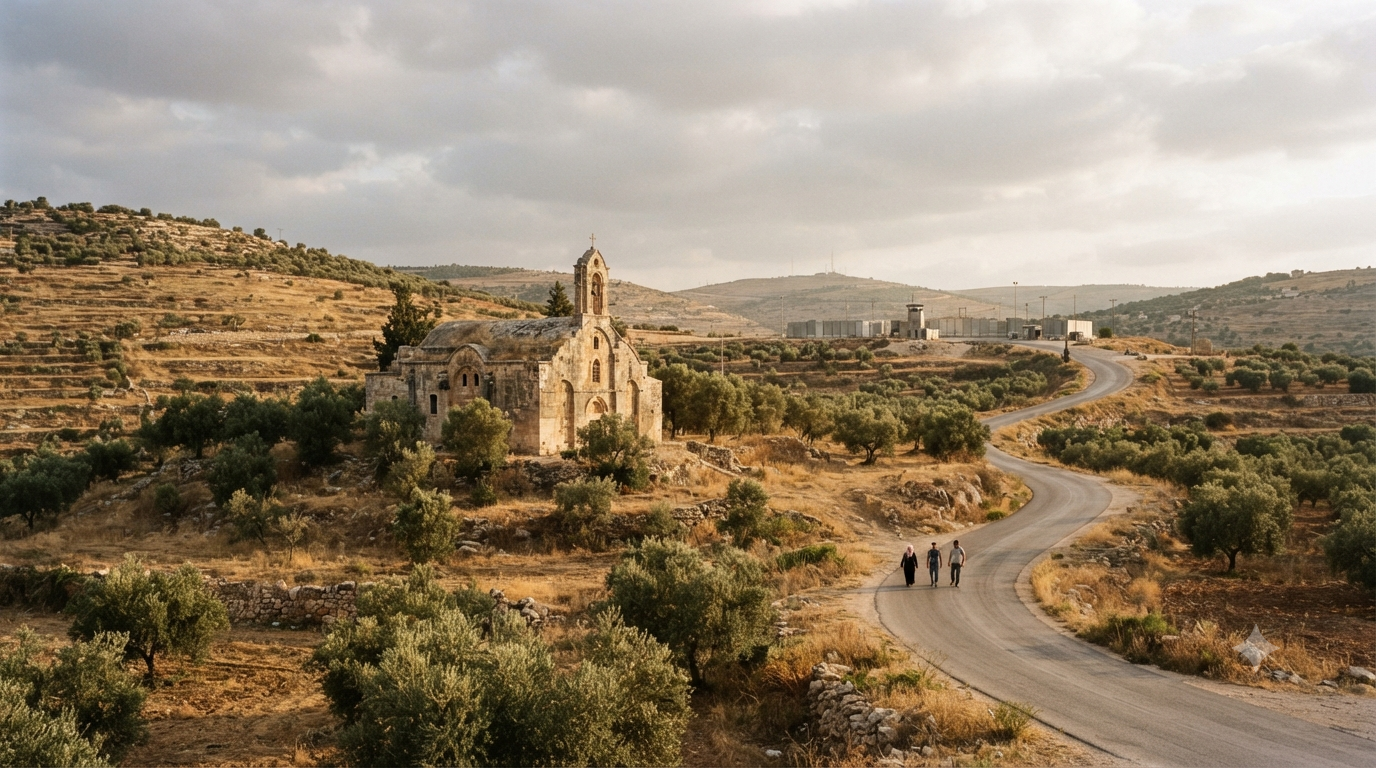
Palestinian Christians Leaving the West Bank Amid Violence and Hardship
Attacks, checkpoints, economic crisis, and insecurity are threatening the survival of historic Christian communities in the Holy Land.
The Christian presence in the West Bank is facing a new wave of insecurity. Since the war in Gaza began in October 2023, residents have reported increased violence, movement restrictions, settler attacks, and worsening economic conditions.
These circumstances are forcing Christian families to leave cities and villages where they have lived for generations. In Taybeh, considered the last entirely Christian community in the West Bank, religious leaders warn that the community’s future is threatened by attacks, population decline, and a lack of opportunities.
A shrinking community
The Palestinian Christian population now represents only a small percentage of the West Bank’s inhabitants. Estimates cited by community leaders and researchers indicate that between 40,000 and 45,000 Christians remain in the region, representing slightly more than 1% of the population. In 1967, they accounted for approximately 6%.
In the Gaza Strip, the situation is even more severe. Only around 600 Christians remain in the territory, which has been devastated by war, according to the figures presented in the report on which this article is based.
Palestinian pastor and theologian Mitri Raheb stated that more than 200 Christian families have left the West Bank since the beginning of the war. He also warned that, if current conditions continue, there may be no Palestinian Christians left in the region by 2050.
This statement should be understood as a warning about the pace of the exodus, not as an inevitable statistical prediction.
What kind of Christianity is practiced in Palestine?
Palestinian Christians do not belong to a single denomination. The community includes Greek Orthodox Christians, Catholics (both Latin Catholics and members of Eastern Catholic churches), Syriac and Armenian Orthodox Christians, Anglicans, Lutherans, Presbyterians, and other Protestant groups.
Despite their liturgical and historical differences, these churches share the central foundations of the Christian faith: belief in one God, in the Trinity (Father, Son, and Holy Spirit), in Jesus Christ as Lord and Messiah, in his death and resurrection, and in the hope of eternal life.
Palestinian Christian life is shaped by communal prayer, baptism, the celebration of the Eucharist or Holy Communion, and the festivals of the Christian calendar. Bethlehem, Jerusalem, Nazareth, and other cities in the region hold a central place in Christian memory because of their connection to the events narrated in the Gospels.
This faith is also expressed through service to society. Christian churches operate schools, hospitals, social centers, and charitable institutions that serve both Christians and Muslims. These organizations play an important role in education, healthcare, and support for Palestinian families.
For this reason, the departure of Palestinian Christians represents more than the decline of a religious group. It threatens the continuity of communities that preserve churches, liturgical traditions, schools, families, and ways of living out the Christian faith in the very land associated with the biblical story.
Violence and checkpoints
Attacks by settlers against Palestinians have become a constant concern in several areas of the West Bank. Humanitarian reports have documented incidents in communities near Ramallah, Nablus, and Jerusalem, including repeated attacks against some villages.
Military checkpoints also make travel between cities and villages more difficult. Taybeh is located approximately 12 kilometers from Ramallah, but the journey can take about an hour because of barriers and inspections.
For residents, these restrictions affect access to work, education, medical services, and commercial activities. Tourism, which for many years helped support several Christian communities, has also been severely affected.
The problem is not only the length of the journey. The unpredictability of closures and the constant sense of insecurity make it more difficult to plan daily life, maintain businesses, and encourage young people to remain in the region.
The case of Taybeh
Taybeh is a small Christian community in the West Bank. It has historic churches and a population that is striving to preserve its Christian identity amid growing instability.
According to Father Bashar Fawadleh, the local Latin Church parish priest, more than 15 families have left Taybeh since 2023. The population, which reached approximately 3,000 people in the 1980s, is now estimated at around 1,200.
The priest identifies two main factors behind the exodus: the lack of security caused by attacks and difficult economic conditions. Without stability, many young people see no realistic way to build a future in their hometown.
Representatives of the Church have described the situation in Taybeh as an unprecedented threat to the community’s land, population, and historic Christian presence.[2]
Why are so many families considering emigration?
Emigration is not an equally accessible option for everyone. Palestinian Christians often have relatives in countries such as the United States, Canada, Australia, and nations across Latin America. These family networks make it easier to find housing, employment, and support abroad.
Varsen Aghabekian Shahin, Palestine’s foreign minister and an Armenian Christian, said that the decline of the Christian population should serve as a serious warning to the Christian world.
Khalil Shikaki, director of the Palestinian Center for Policy and Survey Research, noted that a survey conducted in 2020 found that the desire to emigrate was twice as high among Christians as among Muslims in the West Bank. Since then, security and economic conditions have deteriorated further.
Issa Qassis, a 31-year-old entrepreneur from Ramallah, said that he is considering leaving the region and moving to the United States. He described the difficulty of making professional progress in an environment where every achievement seems to be followed by new obstacles.
An appeal to the Church
Palestinian Christian leaders have called for international action to protect civilians, guarantee freedom of movement, and create conditions that would allow families to remain in their communities.
The Church’s response should not be limited to political disputes. It should also include prayer, solidarity, responsible reporting, and support for the institutions serving local communities.
The words of the Letter to the Hebrews remain relevant:
- “Remember those in prison as if you were with them, and those who are mistreated as if you yourselves were suffering.”
- Hebrews 13:3
The crisis facing Palestinian Christians requires the Christian world to see the Holy Land not only as a place of pilgrimage or as the setting of biblical narratives. It is also home to real people who continue to work, pray, educate their children, and preserve their faith amid violence and uncertainty.
If these communities disappear, the world will lose more than a segment of the population. It will also lose a living, diverse, and historic expression of Christianity in the Middle East.
Sources - A strategy ‘to make life intolerable': Israeli settlers are driving Christians out of West Bank https://www.theguardian.com/world/2026/apr/05/israeli-settlers-driving-christians-out-west-bank - Cisjordânia, o pároco de Taybeh: “Preservar a presença cristã” https://www.vaticannews.va/pt/mundo/news/2026-07/cisjordania-paroco-de-taybeh-preservar-presenca-crista-palestina.html - Conflito entre Israel e palestinos: minoria cristã relata como enfrenta disputa 'na terra de Cristo' - BBC News Brasil https://www.bbc.com/portuguese/internacional-57143976 - Estudo revela o importante papel das instituições cristãs na sociedade palestina - Vatican News https://www.vaticannews.va/pt/igreja/news/2021-03/papel-instituicoes-cristas-sociedade-palestina.html
This article contains affiliate links. We may earn a commission from purchases made through them, at no extra cost to you.