Who Was Isaac in the Bible? The Story, the Faith, and the Son of Promise
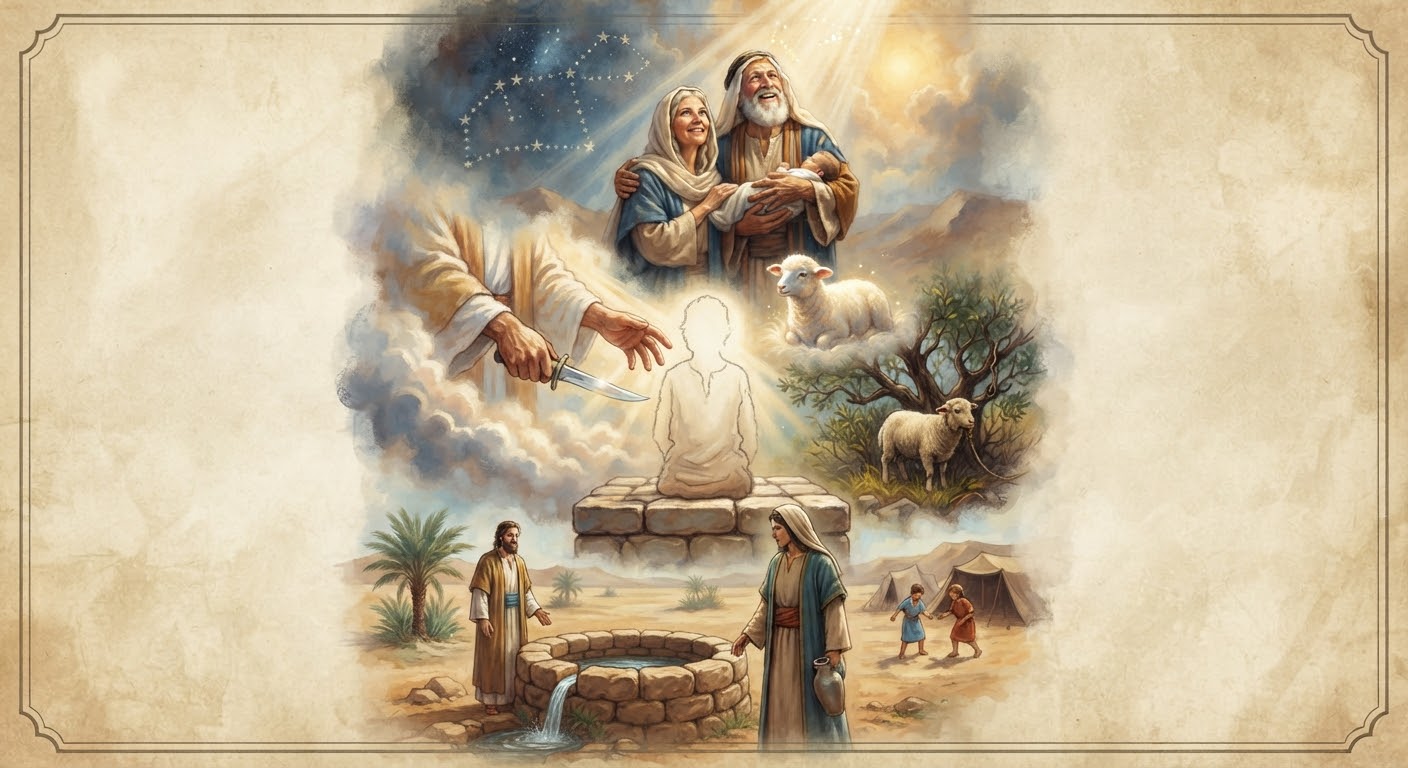
When we think of the biblical patriarchs, Abraham and Jacob usually occupy the most well-known positions. Abraham is remembered as the man called by God to leave his land and receive the promise of a great offspring. Jacob, in turn, is the one whose name will be changed to Israel and whose sons will give rise to the tribes of Israel.
Between the two stands Isaac.
Son of Abraham and Sarah, husband of Rebecca, and father of Esau and Jacob, Isaac occupies a fundamental position in the Genesis narrative. His story does not feature as many journeys and political events as Abraham's, nor does it present the same amount of family conflicts that would mark Jacob's life. Even so, it is precisely through him that the promise received by Abraham crosses a second generation.
Isaac is born when his parents are already elderly, goes through the dramatic episode at Mount Moriah, marries Rebecca, faces his wife's barrenness, lives in Gerar, osper in the midst of territorial disputes, and spends much of his life bound to wells and the land.
His trajectory also raises important historical questions. What can we know about the customs presented in his story? What do Isaac's wells reveal about life in the ancient Near East? Is there archaeological evidence proving his existence? And how did Isaac come to be remembered in Jewish and Christian traditions?
To understand this figure, we need to look at him from three complementary perspectives: the biblical narrative, the historical and cultural context in which this narrative is set, and the significance Isaac acquired in later biblical tradition.
The Birth of Isaac: A Promise That Crossed Decades
The story of Isaac begins before he was born.
In Genesis 12, God had called Abram to leave his land and his kindred and go to a land that would be shown to him. Along with this call came a promise: God would make him a great nation and, through his offspring, bless all the families of the earth.
The problem was that Abram and Sarai had no children.
Throughout the narrative, the absence of an heir becomes one of the main tensions in the story. Abram grows old, Sarai remains barren, and the promise remains unfulfilled.
In Genesis 15, Abram goes as far as asking God if his servant Eliezer would be his heir, since he had no son. God answers by promising that the heir would come from Abram's own body.
Still, the years pass.
Sarai then offers her Egyptian servant Hagar to Abram, following a practice known in ancient Near Eastern societies where a barren woman could resort to a servant to produce offspring within the family structure. From this union, Ishmael is born (Genesis 16).
But the biblical narrative makes it clear that Ishmael would not be the son through whom the specific covenant would continue.
In Genesis 17, when Abram was already 99 years old, God reaffirms the promise and announces something that seemed humanly impossible:
“And I will establish my covenant with him for an everlasting covenant for his offspring after him.”
The "him" would be Isaac, the son Sarah would yet bear.
The name is also significant.
Isaac comes from the Hebrew Yitsḥaq, related to the root ṣ-ḥ-q, associated with laughter. The name is tied to the reaction of Abraham and Sarah when faced with the promise that they would have a son in their old age.
When he is finally born, Genesis 21 presents the event as the fulfillment of what God had announced.
Abraham was one hundred years old.
Sarah was long past the natural age to bear children.
For this reason, within the biblical narrative itself, Isaac is not merely another descendant of Abraham.
He is the son expected for decades and presented as the heir of the promise made to his parents.
Isaac and Ishmael: Two Lineages Within Abraham's Family
The birth of Isaac profoundly alters the family dynamics.
Genesis 21 describes a celebration on the occasion of the child's weaning. During the feast, Sarah notices Ishmael in a situation she interprets as a threat to her son's future and demands that Hagar and Ishmael be cast out.
Abraham is distressed.
God, however, tells Abraham to listen to Sarah, adding that He would also make Ishmael a great nation.
This part of the narrative is important because it avoids a simplistic interpretation.
The biblical text establishes a distinction between the two lineages, but it does not present Ishmael as someone abandoned by God.
Isaac receives the specific role of continuing the covenant made with Abraham.
Ishmael also receives a promise of offspring and prosperity.
The separation of the two brothers, therefore, does not mean that one was blessed and the other cursed.
It establishes different roles within the Genesis narrative.
Isaac remains the heir of the line that will later lead to Jacob and the history of Israel.
Mount Moriah: Isaac Before the Altar
Few episodes in the Bible are as well known as Genesis chapter 22.
After all the events that led to Isaac's birth, God puts Abraham to the test.
The command is extraordinary:
“Take now your son, your only son Isaac, whom you love, and go to the land of Moriah, and offer him there as a burnt offering.” Genesis 22:2
The phrase “your only son” might cause confusion because Ishmael already existed. Within the narrative, however, the expression is related to Isaac's unique position as the son of the promise and the son of Sarah.
Abraham prepares everything for the journey.
He takes two servants, the wood, the fire, and the knife.
After three days, he arrives at the specified place.
Isaac then notices that something is missing.
“Look, the fire and the wood, but where is the lamb for a burnt offering?”
Abraham replies:
“God will provide for Himself the lamb for a burnt offering, my son.”
What happens next is known in Jewish tradition as the Akedah, a Hebrew term associated with the "binding" of Isaac.
Abraham builds the altar, places the wood in order, and binds his son.
Just as he is about to sacrifice him, the angel of the Lord calls out to him and stops the act.
A ram caught by its horns is found and offered in place of Isaac.
What Do We Know About Isaac's Age?
A frequently discussed question is Isaac's age during this episode.
The Bible does not state how old he was.
The text presents Isaac as capable of carrying the wood to be used for the sacrifice, but this does not allow us to establish a precise age.
Some later Jewish traditions developed interpretations in which Isaac was much older than he normally appears in popular depictions. Rabbinic tradition, for example, linked the episode to the age of 37 in certain interpretations.
However, this should not be presented as if Genesis had stated that age.
The biblical text does not say how old Isaac was.
This distinction is important because the biblical narrative and later interpretative traditions are not exactly the same thing.
The Akedah and Its Interpretations
Within the book of Genesis itself, the episode functions as a test of Abraham's faithfulness.
The text also establishes an important contrast with the human sacrifices known in various societies of the ancient world.
At the decisive moment, the sacrifice of Isaac does not take place.
An animal is offered in his stead.
The narrative ends with Abraham calling that place YHWH-yir'eh, traditionally translated as “The Lord will provide.”
Centuries later, Jewish tradition developed a rich interpretation of the Akedah, associating the merit of Isaac and Abraham with the relationship between Israel and God.
In Christianity, the episode also acquired a typological interpretation. The New Testament, especially Hebrews 11:17–19, interprets Abraham's faith in the face of Isaac's potential death and his confidence in God's power to fulfill the promise.
Paul, in turn, uses the story of Isaac in his discussions about promise and offspring.
Thus, an episode originally set within patriarchic history came to occupy an important place in Jewish and Christian theological reflection.
Sarah Dies and Isaac Must Form His Own Family
After the episode at Mount Moriah, Genesis records the death of Sarah.
She dies at the age of 127 and is buried in the cave of Machpelah in Hebron, which Abraham purchased from the local inhabitants.
The episode is also important for a historical and narrative reason.
The purchase of the cave represents the first piece of property formally acquired by Abraham in the land of Canaan.
The family still lives as foreigners and sojourners in the land, but now possesses a permanent site for their dead.
Following Sarah's death, Abraham becomes concerned with Isaac's marriage.
He does not want his son to take a wife from among the Canaanite women and sends his servant to his homeland in the region of Mesopotamia.
Genesis chapter 24 details this mission in full.
Rebecca and Isaac's Marriage
The servant arrives at a city in the region of Aram and stops by a well.
There, he prays to God to allow him to recognize the woman chosen for Isaac through a sign related to hospitality.
Rebecca appears with a pitcher.
When the servant asks for a drink, she offers water to him and to his camels as well.
The gesture demonstrates an extraordinary willingness to show hospitality, especially since drawing water for several animals meant considerable labor.
After learning that Rebecca belongs to the family of Nahor, Abraham's brother, the servant explains the purpose of his trip.
Rebecca agrees to leave.
The episode is interesting because it reveals aspects of marital relationships within patriarchal families.
Marriage is not shown as an exclusively individual choice between two young people. It involves families, kinship, property, and the continuity of the household.
Abraham's concern regarding the origin of Isaac's wife also demonstrates the importance the family placed on group identity.
When Rebecca finally meets Isaac, Genesis records:
“So she became his wife, and he loved her.” Genesis 24:67
From that moment on, Isaac no longer appears solely as Abraham's son.
He begins to form his own household.
Isaac and Rebecca's Barrenness
The narrative, however, repeats a familiar problem.
Rebecca cannot have children.
Genesis 25:21 records an interesting difference compared to the story of Abraham and Sarah:
“And Isaac pleaded with the Lord for his wife, because she was barren; and the Lord granted his plea.”
Rebecca conceives.
The pregnancy, however, is difficult, and she inquires of the Lord to understand what is happening.
The answer announces that two nations are in her womb and that a reversal will occur:
“The older shall serve the younger.”
Esau and Jacob are born.
From this point forward, the Genesis narrative progressively shifts its focus.
The two brothers will have their own history, marked by issues of birthright, blessing, identity, and reconciliation.
Since the goal of this study is to understand Isaac, it is enough to note that with the birth of his sons, a new generation of the patriarchal family enters the stage.
Isaac in Gerar
Genesis 26 presents an episode that shares striking parallels with events in Abraham's life.
A famine strikes the land.
Isaac goes to Gerar, a territory associated with the Philistines and ruled by Abimelech.
God appears to Isaac and commands him to remain in that land instead of going down to Egypt.
At the same time, He reaffirms the promises previously made to Abraham.
It is an important repetition within the narrative: the promise does not end with the first generation.
Yet Isaac also repeats one of his father's behaviors.
Fearing that the men of the place might kill him to take Rebecca, he claims that she is his sister.
Abimelech discovers the truth upon seeing Isaac and Rebecca together.
The king then rebukes Isaac:
“Quite clearly she is your wife! How could you say, ‘She is my sister’?”
The story is very similar to the episodes involving Abraham, Sarah, and foreign rulers.
This repetition likely serves an important literary function.
The text shows that the same struggles can reemerge from one generation to the next.
Isaac inherited from Abraham not only the promise, but also a family history marked by fear, displacement, and delicate relations with neighboring peoples.
Isaac's Prosperity and the Dispute Over Wells
Following the episode in Gerar, the narrative shows Isaac flourishing.
He sows and reaps abundantly.
His flocks increase.
His servants multiply.
His prosperity evokes envy.
Abimelech then asks Isaac to move away because he had become too powerful for the region.
Isaac departs.
It is at this point that wells take center stage.
The Philistines had stopped up the wells that had been dug in the days of Abraham.
Isaac orders them to be reopened and restores their original names.
Then, his servants dig new wells.
The first causes a dispute.
It is named Esek.
Another also leads to conflict and receives the name Sitnah.
Finally, a third well is dug without any quarrel.
Isaac names it Rehoboth:
“For now the Lord has made room for us, and we shall be fruitful in the land.” Genesis 26:22
Why Were Wells So Important?
To understand this part of the story, we must refrain from viewing wells as simple sources of water.
The region where the patriarchal narratives are set consists of vast semi-arid areas.
For pastoral groups and agricultural communities, controlling access to water was vital.
A well could determine where a family could maintain their herds, plant crops, or even whether they could stay in a region at all.
Therefore, the dispute between Isaac's men and the local inhabitants carried an economic and territorial dimension.
It was not merely a quarrel over a hole in the ground.
It was a struggle for an essential resource.
The narrative also establishes a direct link between Abraham and Isaac.
The wells had originally been dug during the father's time.
Isaac reclaims them.
This detail reinforces a key trait of the narrative: the second generation does not start from scratch.
It inherits locations, relationships, memories, and conflicts left by the previous generation.
Beersheba and the Confirmation of the Covenant
After leaving the places of dispute, Isaac arrives in Beersheba.
That night, God appears to him again:
“I am the God of your father Abraham; do not fear, for I am with you.” Genesis 26:24
The language mirrors the promises previously made to Abraham.
God promises to bless Isaac and multiply his descendants for Abraham's sake.
Isaac builds an altar and calls upon the name of the Lord.
Shortly after, Abimelech arrives accompanied by his officers.
Isaac asks why they have come, given that they had previously asked him to leave the area.
Their response reveals a shift in the relationship:
“We have clearly seen that the Lord is with you.”
Abimelech proposes a covenant.
The narrative thus displays an interesting transformation.
Isaac was initially viewed as a threat because of his prosperity.
Now, his former adversaries seek to establish peaceful relations with him.
The story concludes with another reference to a well in Beersheba.
Water, which had been a source of conflict, becomes associated once again with permanence and prosperity.
Isaac and the Blessing of His Sons
The final major phase of Isaac's narrative appears in Genesis 27.
He is now old and his eyesight has failed.
Isaac calls Esau and asks him to prepare a meal before receiving his blessing.
Rebecca, however, overhears the conversation and prepares Jacob to present himself to his father in place of Esau.
The episode involves food, garments, scent, touch, and voice.
Isaac is suspicious, but ultimately imparts the blessing to Jacob.
When Esau arrives, he realizes what has happened.
The episode marks the beginning of a new chapter in the family's history and triggers Jacob's departure.
It is unnecessary to elaborate here on the trajectory of the two brothers.
The crucial point for Isaac's biography is that, in his old age, he becomes the figure through whom the blessing passes to the next generation.
From this point on, the narrative of Genesis gradually shifts its focus.
Abraham had been the dominant figure of the previous generation.
Now, Isaac grows old and Jacob moves to the foreground.
The Death of Isaac
Isaac appears again in Genesis following these events.
Jacob returns to the region of Hebron, where he finds his father.
Genesis then records the death of Isaac:
“So Isaac breathed his last and died, and was gathered to his people, being old and full of days. And his sons Esau and Jacob buried him.” Genesis 35:29
Isaac died at the age of 180.
His burial brings his two sons together.
The scene closes Isaac's generation, but not the story of the promise.
The narrative will now follow Jacob primarily.
Isaac in Later Biblical History
Isaac's importance does not fade after Genesis.
His name becomes part of the very way Israel refers to its origins.
When God appears to Moses, He identifies Himself as:
“The God of Abraham, the God of Isaac, and the God of Jacob.” Exodus 3:6
This formula recurs throughout various Old Testament texts.
It establishes a genealogical and theological sequence:
Abraham → Isaac → Jacob.
In the New Testament, Jesus uses this same formula when arguing about the resurrection:
“I am the God of Abraham, the God of Isaac, and the God of Jacob.” Matthew 22:32
Paul also references Isaac in his arguments concerning the promise and offspring.
In Romans 9, he distinguishes physical descent from relationship to the promise, using Isaac as an example.
In Galatians 4, he again cites Isaac as a reference to the child of the promise.
Hebrews 11 includes Isaac among the patriarchs who lived by faith, mentioning specifically the moment he blessed Jacob and Esau.
Thus, Isaac ceased to be merely a figure in the Genesis narrative.
His name became part of the religious memory of Israel and, later, of Christian theology.
Isaac from a Historical and Archaeological Perspective
When transitioning from the biblical narrative to historiography, we must exercise the same caution required when studying Abraham.
To date, there are no contemporary inscriptions mentioning Isaac directly that would confirm his individual existence.
Nor is there an archaeological discovery that can be identified as “Isaac's well” or as direct proof of a specific event narrated in Genesis 26.
This does not mean the setting described by the narrative is historically impossible.
On the contrary, many elements of the story—herding, migration during famines, disputes over water, alliances between local chieftains, marriage within extended families, and trade routes between Canaan and Mesopotamia—align with known aspects of ancient Near Eastern societies.
However, cultural plausibility is not the same as historical proof.
This distinction is crucial.
The Patriarchs and the Question of Dating
For much of the 20th century, scholars like William F. Albright argued that the patriarchal narratives preserved historical memories from the second millennium BCE, linking customs described in Genesis to materials found in archaeological sites across the ancient Near East.
Later, this position was strongly challenged.
Researchers began drawing attention to issues regarding the literary composition of Genesis, anachronisms, editorial layers, and the transmission of patriarchal traditions.
This made the issue far more complex.
Today, there is no academic consensus that allows us to simply state:
“Isaac lived in exactly year X, and all events in Genesis can be historically reconstructed.”
At the same time, it would also be an overreach to conclude that the entire patriarchal tradition was fabricated at a late period without preserving any earlier memory.
The most responsible approach is to acknowledge the complexity.
Genesis is a literary and theological text that preserves ancient traditions, but its final form is the result of a long process of transmission and composition.
The World of Wells
The wells mentioned in Isaac's story offer an interesting example.
The significance of water in arid regions is historically well documented.
Wells and cisterns were vital to the survival of pastoral groups and communities.
Place names could also preserve the memory of events related to water, disputes, or territorial occupation.
This makes the type of conflict presented in Genesis 26 plausible.
Yet, we cannot leap from this observation to claiming that archaeology has proven the story of Isaac.
What we can say is that the social setting described in the narrative features elements consistent with the ancient Near Eastern environment, while the direct historical identification of the patriarch himself remains unconfirmed outside biblical texts.
Who Was Isaac?
Within the biblical narrative, Isaac occupies a unique position.
He is not presented as the founder of the promise.
That role belongs to Abraham.
Nor is he the one who gives his name to the nation of Israel.
That happens through Jacob.
Isaac stands between these two generations.
His role is that of heir and transmitter.
He receives the promise given to Abraham, establishes his own family, remains in the land, faces local conflicts, and passes the blessing to the next generation.
His story is marked less by great journeys than Abraham's was.
Instead, Genesis emphasizes permanence.
Isaac is associated with Beersheba, Gerar, wells, his household, and his family.
Even when confronting conflicts, the narrative often shows him moving elsewhere rather than turning every dispute into a war.
This characteristic gives his story a different rhythm.
Abraham is constantly called to depart.
Isaac is frequently called to remain.
Isaac's Legacy
The importance of Isaac is evident precisely in the position he occupies within the narrative progression.
He is born in fulfillment of the promise made to Abraham.
He survives the episode on Mount Moriah.
He marries Rebecca.
He becomes a father.
He receives the confirmation of the covenant once again.
He settles in the land.
He reopens the wells tied to his father.
He deals with Abimelech.
And finally, he passes the blessing to the next generation.
When he dies at the age of 180, his name is firmly bound to the identity of the patriarchs.
The formula that appears repeatedly throughout Scripture summarizes his position:
The God of Abraham, Isaac, and Jacob.
Three generations.
A single story.
And it is with the next generation that Genesis begins to move toward a new stage.
Abraham's story began with a call to leave his land.
Isaac's was marked by the continuity of the promise.
Jacob's will lead the narrative to the sons who will form the tribes of Israel.
Isaac, therefore, is not merely the character between Abraham and Jacob.
He is the patriarch through whom the promise passes from one generation to the next.
This article contains affiliate links. We may earn a commission from purchases made through them, at no extra cost to you.