Before Jesus: The world that prepared the way for Christianity
Before Jesus: The world that prepared the way for Christianity
Christianity did not emerge in a vacuum. Centuries of empires, wars, exiles, and cultural shifts prepared the stage for the birth of Jesus.
Imagine waking up in Jerusalem around the year 30 AD.
The streets are filled with merchants from different regions of the Roman Empire. Soldiers patrol the city. Pilgrims arrive at the Temple to celebrate one of the great Jewish feasts. The air mixes the smell of animals destined for sacrifices with the intense movement of people.
Some speak Aramaic. Others converse in Greek. Government officials use Latin. Foreign merchants bring products from places that many inhabitants will never know.
Meanwhile, different groups passionately debate religion, politics, and the future of Israel.
Some await a king chosen by God.
Others believe that a great revolt will expel the Romans.
There are those who expect an ideal priest.
Others speak of a prophet similar to Moses.
Some live secluded in the desert, convinced that God will soon intervene in history.
It is into this world that Jesus is born.
But none of this appeared overnight.
To understand Christianity, we need to go back several centuries and follow the long sequence of events that prepared this scenario.
Christianity has deep roots
When we think of the beginning of Christianity, it is common to imagine that everything started with the birth of Jesus.
In fact, his followers were Jews.
They read the Scriptures of Israel.
They frequented the Temple and the synagogues.
They knew the stories of Abraham, Moses, David, and the prophets.
The early Christian communities did not believe they were creating a completely new religion. They understood that the events linked to Jesus were part of the continuity of God's story with the people of Israel.
Therefore, knowing Christianity requires also knowing the Jewish world in which it emerged.
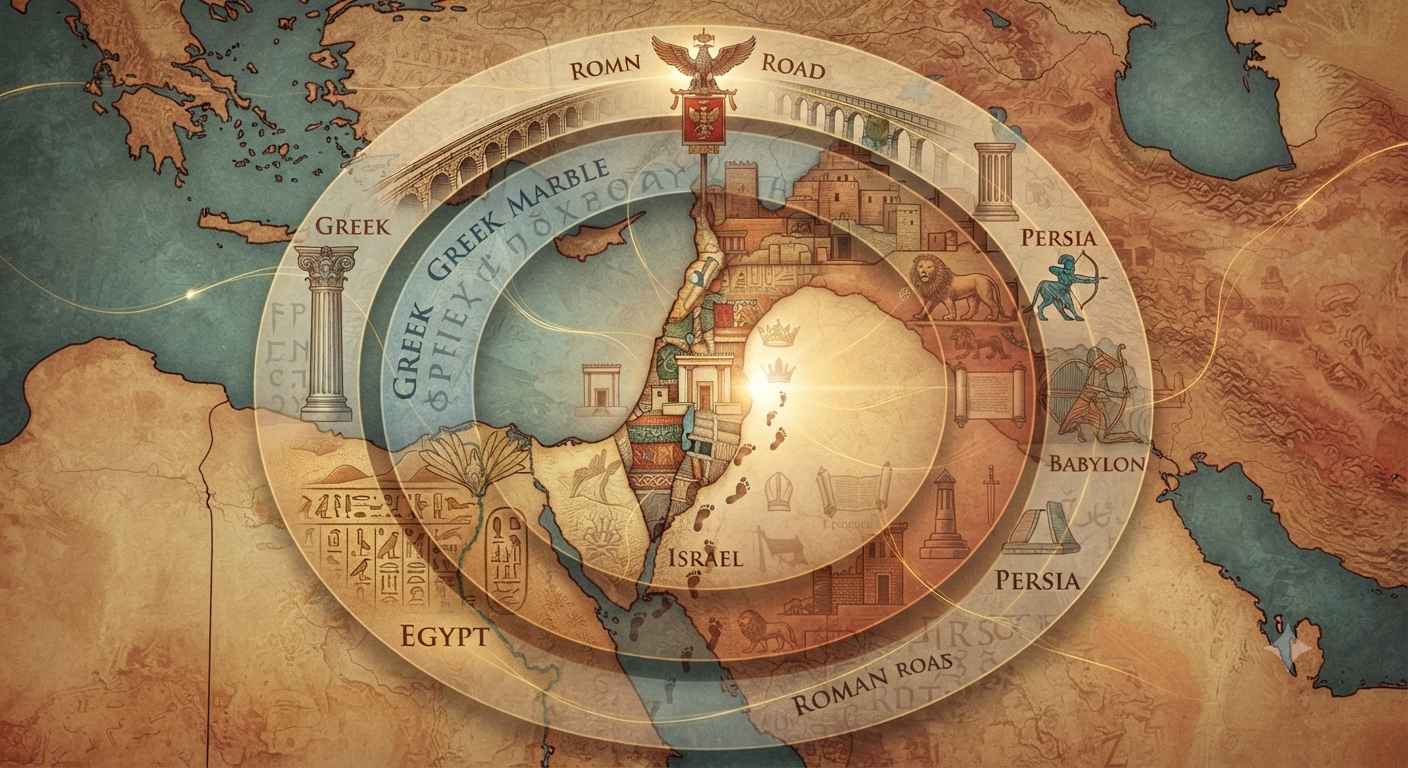
Israel was at the center of great empires
The territory of Israel was never an isolated island.
Its geographical position connected Egypt, to the south, to the great powers of Mesopotamia, to the north and east.
Whoever controlled this region dominated important trade, military, and political routes.
Over the centuries, different empires exerted influence over that small territory:
- Egyptians;
- Assyrians;
- Babylonians;
- Persians;
- Greeks;
- Romans.
Each left deep marks on culture, politics, and even the way Jews understood their own identity.
The exile changed everything
One of the most important events in Jewish history occurred in the 6th century BC, when Jerusalem was conquered by the Babylonians.
The Temple was destroyed.
Much of the population was taken into exile.
To many, it seemed like the end of Israel's history.
But the exact opposite happened.
During this period, the religious identity of the people was strengthened.
Traditions began to be preserved with even more care.
The Scriptures gained growing importance.
The hope of restoration became a central part of religious life.
Many scholars consider that this period profoundly shaped Judaism as it would exist centuries later.
The return did not mean independence
When the Persian Empire conquered Babylon, many Jews were able to return to their land.
The Temple was rebuilt.
Jerusalem came to exist once again as a religious center.
But Israel was no longer an independent kingdom.
It continued living under the rule of major empires.
This experience of depending on foreign powers would profoundly mark its history until the time of Jesus.
The impact of Greece
In the 4th century BC, a new character completely changed the known world.
Alexander the Great.
In a few years, his empire extended from Greece to Egypt and India.
More important than his military conquests was the diffusion of Greek culture.
The Greek language became the main international language of the Eastern Mediterranean.
Cities began to adopt Greek customs.
Philosophy gained enormous influence.
Trade expanded.
Even after Alexander's death, his cultural heritage remained alive for centuries.
When the New Testament was written, for example, Greek was already the most widespread language in the region.
This explains why Christian writings circulated so quickly among different peoples.
The Maccabean Revolt
Not everyone easily accepted foreign influence.
In the 2nd century BC, policies imposed by the Seleucid ruler Antiochus IV provoked a major revolt led by the Maccabean family.
This conflict was not only military.
It also involved identity, religious freedom, and fidelity to Jewish traditions.
The victory of the Maccabeans led to the rise of the Hasmonean dynasty and further fueled the hope that God would fully restore Israel.
This memory was still alive in the time of Jesus.
Then Rome arrived
In 63 BC, the Roman general Pompey conquered Jerusalem.
From that moment on, the region became part of the Roman sphere of influence.
Rome did not rule solely by military force.
It also managed taxes, roads, commerce, and political alliances.
Herod, known as Herod the Great, governed Judea with Roman support.
It was he who promoted a massive expansion of the Temple in Jerusalem, transforming it into one of the most impressive buildings of the ancient world.
At the same time, his government was marked by tensions, constant surveillance, and repression of potential rivals.
When Jesus was born, this was the political scenario.
A people full of expectations
After so many centuries of foreign domination, many Jews expected a major intervention from God.
Expectations varied.
Some awaited a descendant of King David who would restore the kingdom.
Others expected a new Moses.
Some spoke about a perfect priest.
Others believed that God would definitively defeat the enemy nations.
These expectations appear in various Jewish writings produced before the time of Jesus.
Not everyone imagined the same type of Messiah.
But practically all shared the hope that God still had something in store for Israel.
A connected world
Sometimes we imagine the ancient world as a set of isolated peoples.
In reality, the Mediterranean was a huge network of cities connected by roads, ports, and trade routes.
Traveling was still slow and difficult.
But people, goods, ideas, and news circulated constantly.
This infrastructure, built mainly by the Romans, would help, a few decades later, in the rapid expansion of Christianity.
Missionaries could travel hundreds of kilometers using relatively safe roads and a language understood by a large part of the eastern world: Greek.
Why does all this matter?
Without this context, many passages of the Gospels become difficult to understand.
Why were there tax collectors?
Who were the Pharisees?
Why were there Roman soldiers in Judea?
Why did so many people expect a Messiah?
Why did Jerusalem attract pilgrims from so many places?
Why were the apostles able to proclaim the message of Jesus in different cities of the Empire?
None of these questions can be answered by looking solely at the birth of Jesus.
They are part of a much longer history.
The story of Jesus begins before Jesus
When we open the Gospels, we encounter characters, cities, religious traditions, and conflicts that had already existed for centuries.
Nothing appears by chance.
Christianity is born within a much larger history.
A history of alliances, exiles, reconstructions, empires, conquests, and hope.
It is precisely this history that we are going to explore from now on.
In the upcoming articles, we will walk chronologically through the events that shaped Israel and prepared the stage for the birth of Jesus.
The better we understand this world, the clearer the Gospels, the writings of the apostles, and the development of Christianity over the centuries will become.
Next article
Israel: where did the Jewish people come from?
Before there were kings, temples, and famous prophets, there was a family.
How did a small group of people give rise to the people who would profoundly influence the history of monotheistic religions?
It is this journey that we will begin to explore in the next chapter.
This article contains affiliate links. We may earn a commission from purchases made through them, at no extra cost to you.