How do we know what really happened in the past?
How do we know what really happened in the past?
Before studying Christianity, we need to understand how we can know history.
You weren't there.
You never walked the streets of first-century Jerusalem, never saw a Roman soldier, never spoke with a Jew who lived two thousand years ago, and obviously, you never saw Jesus personally.
So how can we claim anything about that period?
This is a more important question than it seems. After all, when we discuss history—especially religious history—it's common to hear that "everyone has their opinion" or that "no one can know what really happened."
But is that really the case?
If we could only know what we personally witnessed, virtually all of human history would disappear. We would have no way of knowing with certainty that Julius Caesar existed, that the Roman Empire ruled certain territories, or that Jerusalem was destroyed by the Babylonians.
We know these things because the past left traces.
And it's from these traces that we try to reconstruct it.
The past leaves evidence
People die, cities disappear, and empires cease to exist. But not everything vanishes with them.
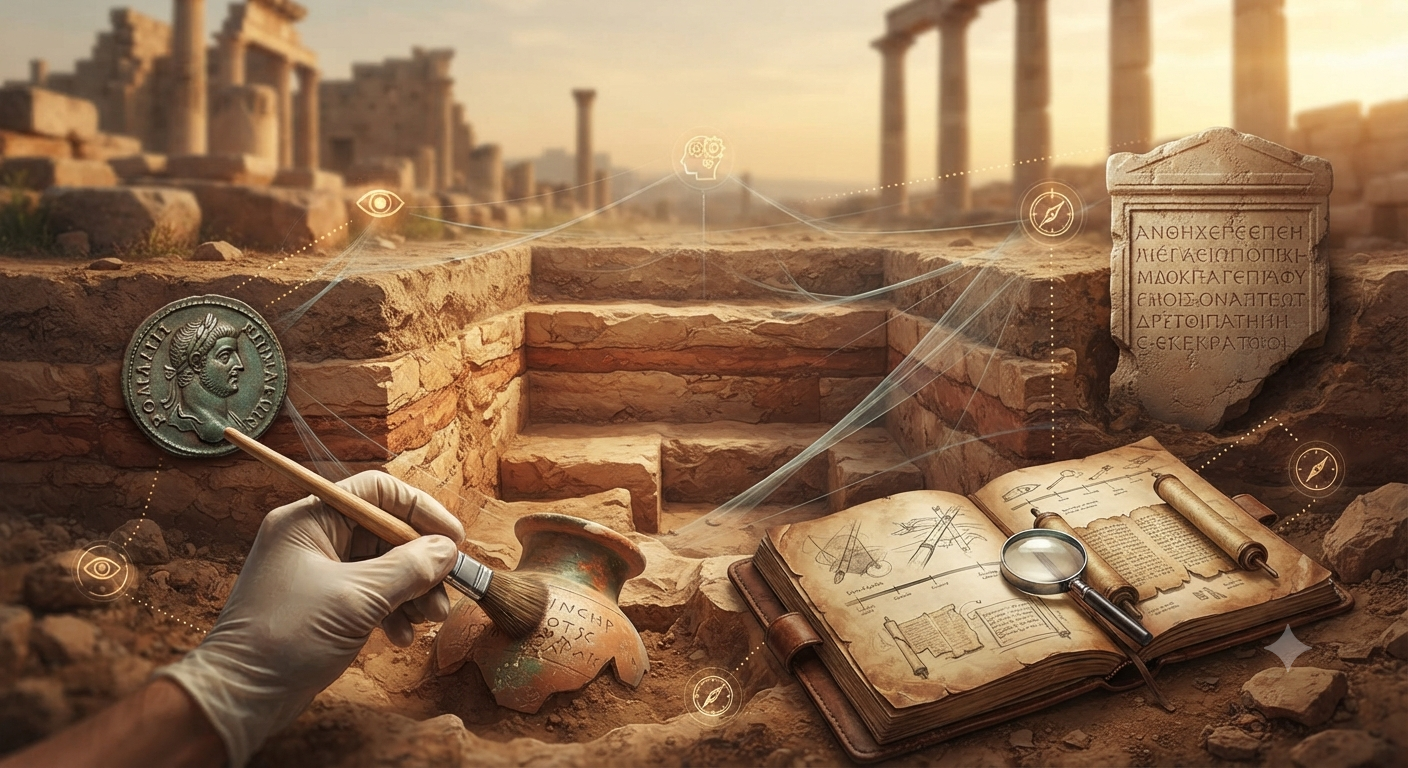
A coin can bear the face and name of a ruler. An inscription can record the name of a person or a city. Ruins can show how a society built its temples and houses. A document can preserve a letter written thousands of years ago. A pottery fragment can reveal the daily habits of a community.
This is why history doesn't depend solely on written accounts.
Archaeology, inscriptions, coins, manuscripts, architecture, objects, and many other traces can help reconstruct the past.
And there's something even more important: these pieces of evidence can be compared.
Imagine that a document mentions a particular city. Finding ruins that match the description adds another layer of evidence. If we also find coins from that period, related inscriptions, and references in other sources, we begin to have a much more consistent picture.
This is how historical knowledge gains strength.
Not because a single source says something, but because different pieces of evidence can point in the same direction.
An ancient source isn't automatically true about everything
This also needs to be clear from the start.
Finding an ancient text doesn't mean everything it claims happened exactly as written.
A king could record his victories in an inscription and present his deeds in the most glorious way possible. A writer could defend his group or his religion. A witness could remember something incorrectly.
That's why historians don't just ask:
- "What does this source say?"
They also ask:
Who wrote it?
When did they write it?
Where were they?
For whom did they write?
Why did they write it?
What information could they have known?
Are there other pieces of evidence that confirm or contradict the account?
These questions aren't meant to discard sources. On the contrary. They serve to discover how much we can trust each one and for which questions they are actually useful.
What does "primary source" mean?
You will likely encounter this expression many times during our journey.
A primary source is, broadly speaking, evidence directly related to the period or event we are studying. It can be an inscription, a coin, a letter, an administrative document, a manuscript, or an archaeological object.
But there's an important thing not to confuse:
primary source does not mean infallible source.
A letter written by someone who witnessed a particular event can be extremely important evidence. Still, its author may have been mistaken, omitted information, or presented the facts according to their own perspective.
Therefore, proximity to an event is valuable, but it does not eliminate the need for analysis.
And what are secondary sources?
They are later studies that analyze and interpret the available evidence.
A contemporary historian, for example, can study manuscripts, inscriptions, coins, ancient texts, and archaeological discoveries to try to reconstruct a particular period.
This is precisely why serious historical research doesn't typically rely on a single source.
It compares evidence, considers different arguments, and seeks to explain which interpretation best holds up against the available body of evidence.
But then what can we call a "fact"?
Here we begin to enter a distinction that will be important throughout this journey.
Consider two statements:
- Rome ruled Judea in the first century.
and:
- The Roman presence was the primary cause of all social tensions in Judea.
Both are statements about the same period, but they do not have the same degree of certainty.
The first has an enormous amount of historical evidence.
The second requires a much more complex interpretation. There are different factors that need to be considered, and historians may disagree on the weight of each.
This is why we shouldn't treat all historical claims as if they were equally certain.
Some are extremely well-established. Others are highly probable. Some are possible but still debated. And there are those that rely primarily on conjecture.
Recognizing this difference is one of the things that most helps separate serious historical investigation from a discussion based merely on opinions.
Fact, interpretation, and opinion
Imagine that archaeologists find evidence that an ancient city was destroyed.
We may have enough certainty to state:
- The city was destroyed.
But that doesn't automatically answer the question:
- Why was it destroyed?
Perhaps there is evidence of a war. In that case, we can formulate the hypothesis that the destruction occurred during a military conflict.
But someone could go further and claim that the city was destroyed because a particular deity decided to judge it.
That last statement belongs to a different kind of discussion.
It doesn't mean it's an unimportant statement or that it can't be an object of faith. It means that we cannot treat it as if it were demonstrated by archaeology in the same way we demonstrate the existence of a building or a city.
This distinction will be important for what lies ahead.
And where does faith come in?
If we are going to study Christianity seriously, we also need to be honest about the limits of historical investigation.
There are questions that can be investigated historically:
- Did Jesus exist?
- In what period did he live?
- Where did he live?
- Who were his followers?
- How did the Christian movement emerge?
- What did the first Christians believe?
But there are other questions that go beyond what the historical method, by itself, can establish:
- Is Jesus the Son of God?
- Did God raise Jesus from the dead?
- Does Jesus' death have meaning for salvation?
- Was God acting through these events?
These are theological questions.
They may involve history, philosophy, testimonies, and many other arguments, but they should not be confused with a simple archaeological question.
This doesn't make faith irrational.
It also doesn't mean that history is incapable of saying anything about Christianity.
It only means that different questions require different forms of investigation.
"If we can't prove everything, then everything is just opinion?"
No.
This is one of the most common mistakes when we talk about the past.
Imagine a criminal investigation. We may never know every detail of a crime. There may not be a recording of every moment, and perhaps some questions remain unanswered.
Still, we can have witnesses, documents, images, objects, location records, and enough other evidence to reach a very strong conclusion.
The fact that we don't have perfect knowledge doesn't mean we don't have any knowledge.
History works in a similar way.
Not knowing everything doesn't mean knowing nothing.
And when sources disagree?
They can disagree. And that's not necessarily a problem.
When we find two different versions of an event, we don't need to simply choose the one we like best.
We can compare the sources.
Which one is older? Who wrote it? Was the author close to the events? Did they have access to relevant information? Did they have any motive to present a particular version? Do other sources confirm either version? Does archaeology help clarify the issue?
Sometimes this process allows us to reach a fairly certain conclusion.
Sometimes one explanation becomes more probable than another.
And sometimes we reach a much simpler conclusion:
- We still don't know.
That last answer may seem frustrating, but it is much better than filling a gap with something the evidence does not allow us to assert.
What can archaeology tell us?
Archaeology will be an important tool in our journey because it allows us to know aspects of the past that don't depend exclusively on texts.
It can reveal cities, buildings, roads, coins, inscriptions, utensils, religious structures, funerary practices, and many other traces.
But we also need to know its limits.
An excavation can show that a particular temple existed. It can show that people gathered there and that a particular deity was worshipped.
But the existence of a temple, by itself, does not demonstrate that the deity actually existed.
Archaeology can demonstrate that a belief existed. That is different from demonstrating that what people believed was true.
This difference may seem small, but it is fundamental.
And the Bible?
Throughout this journey, the Bible will have a central role. But we will also need to learn to study it historically.
The Bible is not a single type of book. It brings together different genres, periods, authors, and contexts.
We find in it narratives, laws, poetry, wisdom literature, prophecies, letters, and apocalyptic texts, among others.
Furthermore, the biblical texts were transmitted through different manuscripts and traditions. To study them, we need to consider questions such as language, historical context, textual transmission, and the formation of the collections.
This will lead us further on to a question that will be especially important for the Canon:
- Why do different Christian traditions have different collections of biblical books?
But we are not yet ready to answer it.
First, we need to build the context.
A rule for our journey
From here on, whenever we encounter a historical claim, it's worth asking three simple questions:
What is the evidence?
Where did this information come from?
What does this evidence actually allow us to conclude?
Are we dealing with a well-established fact, an inference, or a hypothesis?
What do we still not know?
What are the limits of our conclusion?
These three questions will help us avoid two extremes.
On one hand:
- "It's true because someone said so."
On the other:
- "We can't have absolute certainty, so no one can know anything."
History lies between these two extremes.
Now we can begin
Perhaps you're thinking:
- "Alright. But what does this have to do with Jesus?"
It has everything to do with it.
Jesus didn't appear in an empty world.
He was born in a region that had gone through centuries of wars, empires, cultural changes, political conflicts, and religious transformations.
Before Jesus, there was Israel.
There was the Babylonian exile.
There was Persian rule.
There was Alexander and the Hellenistic world.
There was the Maccabean revolt.
There were the Hasmonean kings.
There was the arrival of Rome.
There was Herod.
There was Jerusalem and the Second Temple.
There were different Jewish groups and different expectations about the future.
All of this was part of the world into which Jesus was born.
That's why, before we ask "who was Jesus?", we first need to ask:
- "In what world was Jesus born?"
That's what we're going to investigate next.
We won't start from a ready-made conclusion.
We will go back in time, examine the available evidence, and build the context step by step.
And when something is well-established, we will say it is well-established.
When there is debate, we will show that there is debate.
When there is only a hypothesis, we will not present it as fact.
And when we come to questions of faith, we will make it clear that we are dealing with a different kind of question.
Because understanding history doesn't require you to abandon your convictions.
It only requires that you be willing to ask:
"How do we know that?"
This article contains affiliate links. We may earn a commission from purchases made through them, at no extra cost to you.