What is Christianity?
What is Christianity?
Before studying its history, we need to understand what we are calling "Christianity."
When someone says "Christianity," you probably already picture something.
Perhaps a church. Perhaps a Bible. Perhaps Jesus. Perhaps a cross, a prayer, or a celebration.
But there is a problem: these things, by themselves, do not explain what Christianity is.
And if you start researching the subject, you will quickly find an enormous number of different traditions, churches, doctrines, and interpretations.
Catholics.
Orthodox.
Protestants.
Anglicans.
Copts.
Ethiopians.
Armenians.
Church of the East.
And many other communities and denominations.
So a very reasonable question arises:
- If there are so many different forms of Christianity, what exactly makes something Christian?
To answer that, we need to go back to the beginning.
Christianity begins with a person
The name "Christianity" is linked to Christ.
And "Christ" is not originally Jesus' last name.
It is a title.
The word comes from the Greek Christós, related to the Hebrew Mashiach, usually translated as Messiah or Anointed One.
Therefore, when we speak of Jesus Christ, we are speaking of:
Jesus, the Christ.
Christianity was born around what his first followers claimed about this man.
But who was Jesus?
That question will be the focus of a later stage in our journey.
For now, it is enough to grasp something fundamental:
Christianity did not begin as an abstract idea.
It emerged around a person who lived in a specific period, in a specific region, and within a specific religious tradition.
Jesus was Jewish.
His first disciples were Jewish.
And the movement that arose around him was born within the Jewish world of the first century.
This will be extremely important when we begin to study the context prior to Christianity.
Christianity did not appear out of nowhere
It is common to imagine history more or less like this:
- Old Testament → Jesus → Christianity.
The sequence is true in a very general sense, but it leaves out centuries of history.
Between the ancient Israelites and the birth of Jesus, many things happened.
Israel went through different political periods.
Jerusalem was destroyed.
The Jewish people went through exile.
Empires succeeded one another.
The region was under Persian and later Hellenistic rule.
Greek culture exerted enormous influence.
The Maccabean revolt transformed Jewish history.
The Hasmonean dynasty emerged.
Rome entered the region.
Herod became king.
Jerusalem and the Second Temple took on even greater importance.
And different Jewish groups developed different ways of understanding the Law, the Temple, purity, the future of Israel, Roman rule, and God's action in history.
It is in this world that Jesus was born.
Therefore, studying Christianity requires first knowing the world that produced it.
So, is Christianity a religion?
Yes, but that answer is still too small.
Christianity is a religious tradition that developed from the life, teachings, death, and what his followers claimed about the resurrection of Jesus.
But it also became a tradition:
- theological;
- liturgical;
- communal;
- philosophical;
- cultural;
- historical;
- textual.
Over the centuries, Christians produced texts, built churches, developed forms of worship, formulated doctrines, organized communities, and deeply discussed questions about God, Jesus, the Holy Spirit, salvation, the Church, and the Scriptures.
This means that studying Christianity is not just studying a belief.
It is also studying a human history of approximately two millennia.
But do all Christians believe the same things?
No.
And this is one of the first things we need to understand.
There are deep differences between Christian traditions.
But there are also elements that appear, in different ways, throughout much of historical Christianity.
Among them is belief in:
a creator God;
Jesus as the Christ;
the Scriptures as foundational texts of the faith;
the death and resurrection of Jesus as central events of the Christian faith;
the importance of baptism and community;
the hope of resurrection and future life.
The way each tradition understands these elements can vary greatly.
And some differences are so significant that they ended up contributing to separations between Christian communities.
That is precisely why, further on, we will need to study the history of controversies, councils, and different Christian traditions.
But we should not start at the end.
First we need to understand how we got there.
An important word: Church
Today, when we hear "church," we might immediately think of a building.
A church can be a building, but the word has a much broader meaning in Christian history.
The Greek term ekklesía relates to an assembly or gathering.
In Christianity, it came to be used to speak of the community of Jesus' followers.
Therefore, when the first Christians spoke of the Church, they were not thinking merely of a structure.
They were speaking of a community.
This distinction will be important when we study the first centuries of Christianity.
And the Bible?
Here another question appears that seems simple, but is not.
If we ask:
- "What is the book of Christianity?"
The answer will probably be:
- The Bible.
But the Bible is not a single book written at one time.
It is a collection of books produced in different periods, contexts, and literary genres.
It brings together texts that were written, copied, preserved, and transmitted over many centuries.
And there is an even more interesting question:
- Do all Christians have exactly the same books in the Bible?
No.
Different Christian traditions have differences in their collections of books.
This is where we begin to approach one of the central subjects of the Kanon.
But we need to be careful not to jump immediately into the discussion of "which canon is right."
Before that, we need to understand how these collections emerged and how different Christian communities received and transmitted their Scriptures.
That will be one of the subjects of our journey.
Why are there so many types of Christianity?
This question does not have a single answer.
The differences between Christians arose at different times and for different reasons.
Some are related to theological questions.
Others involve language, culture, politics, geography, ecclesiastical authority, liturgy, or interpretation of the Scriptures.
Some separations resulted from debates that lasted decades or centuries.
Others happened due to political events or historical shifts.
That is why it is dangerous to tell history simply as:
- "One group was right and the other was wrong."
That conclusion may be part of a particular tradition's religious conviction, but it does not replace historical investigation.
If we want to understand what really happened, we first need to reconstruct the events.
After that, we can discuss their interpretations.
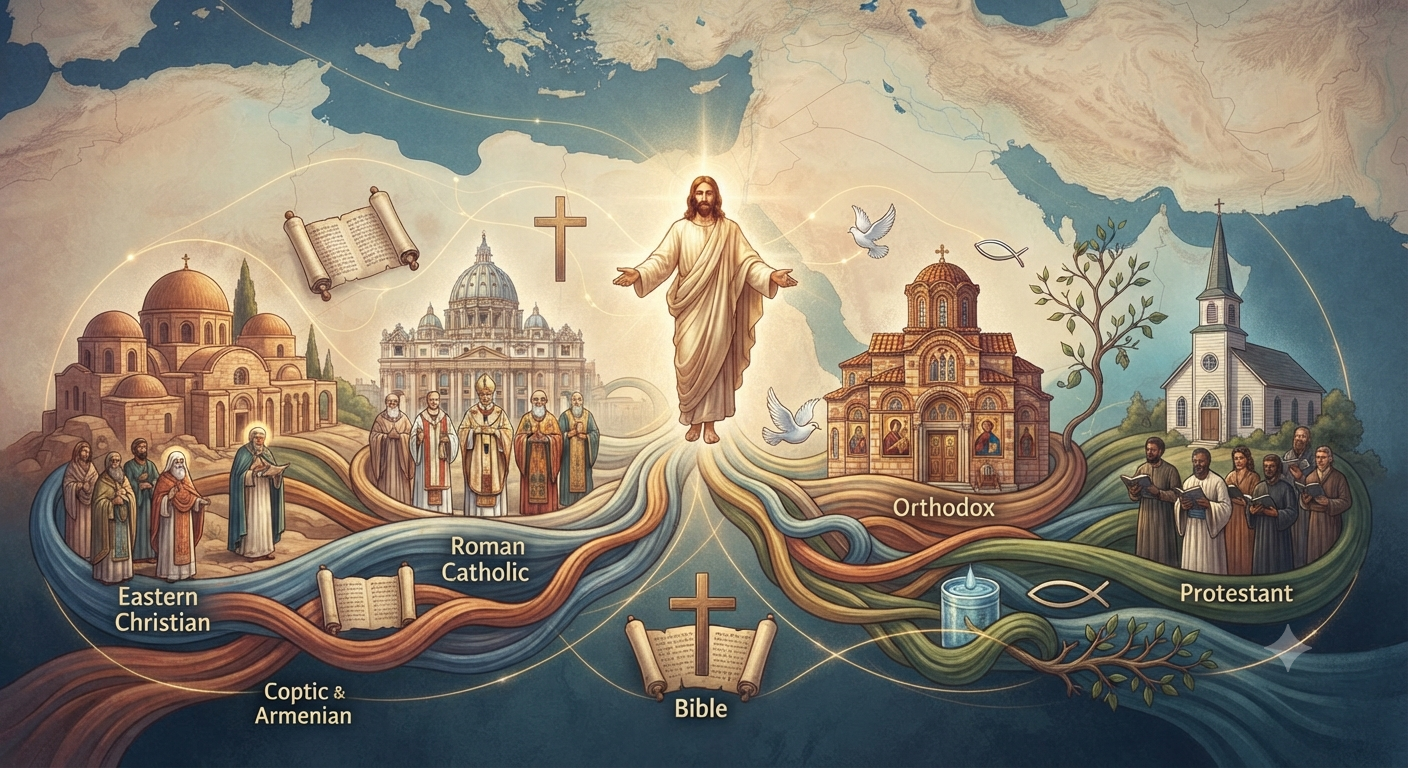
The great families of Christianity
When we study Christian history, we will encounter different major traditions.
Among them are:
Catholic Christianity
The tradition that recognizes the bishop of Rome, the pope, as a central authority in the Catholic Church.
Byzantine Orthodox Christianity
A group of churches that preserved the Eastern Christian tradition associated with the Byzantine Empire and do not recognize papal authority in the Catholic mold.
Oriental Orthodox Churches
Among these are the Coptic, Syriac, Armenian, Ethiopian, Eritrean, and Malankara traditions.
It is here that we find the Ethiopian Orthodox Tewahedo Church, which will have special importance in our journey.
Church of the East
An Eastern Christian tradition with its own history, especially important in Mesopotamia and later in regions of Asia.
Protestantism
A very broad set of traditions that emerged mainly from the Reformation of the sixteenth century and later diversified into countless churches and movements.
These categories are useful for us to begin orienting ourselves, but we should not treat them as if they were completely uniform blocks.
Each has its own internal history.
"So which one is the true Christianity?"
That is a legitimate question.
But it is a different question from:
- "How did these traditions emerge?"
The first involves theology, religious authority, and convictions of faith.
The second can be investigated historically.
And this distinction will be an important rule in our journey.
We do not need to decide everything before knowing the history.
First, let us discover:
what happened?
when did it happen?
who was involved?
what sources do we have?
what can we assert with confidence?
Afterward, we will be better able to understand the different interpretations.
Christianity is also a history of communities
One of the greatest mistakes when studying early Christianity is to imagine that there was a single, perfectly uniform Christian community from the very first day.
Reality seems to have been much more complex.
Christian communities emerged in different places.
Jerusalem.
Antioch.
Alexandria.
Rome.
Asia Minor.
Syria.
Mesopotamia.
North Africa.
And, later, many other regions.
These communities shared important elements, but they also lived in different cultural and linguistic contexts.
This helps explain why, over time, we find different ways of celebrating, teaching, interpreting, and organizing Christian life.
The history of Christianity is, to a large extent, also the history of how these communities related to one another.
And why does this matter to you?
Perhaps you came this far only because you are curious about the Bible.
Perhaps you have heard about Enoch.
Perhaps you came across some discussion about the councils.
Perhaps you saw someone saying that a particular Bible has more books than another.
Perhaps you heard about the Ethiopian Church.
Or perhaps you simply want to understand where Christianity came from.
All of these questions are connected.
It is not possible to fully understand the biblical canon without knowing the history of the communities that transmitted these texts.
It is not possible to understand the councils without knowing the controversies that led to them.
It is not possible to understand the divisions among Christians without knowing the events that produced them.
And it is not possible to understand Jesus properly without knowing the Jewish world in which he lived.
Everything is connected.
A journey, not a collection of answers
That is why this series was not designed as a sequence of random articles.
We want to build a path.
First, we will learn how to investigate the past.
Then, we will get to know the world that existed before Jesus.
After that, we will study Jesus and the movement formed around him.
Then we will follow the first Christians and the expansion of the Church.
Next, we will enter the history of the Bible, manuscripts, and canons.
Only then will we be prepared to understand the controversies and councils that marked Christian history.
After that, we will be able to follow the development of different Christian traditions.
And finally, we will arrive at the tradition that is especially important for the Kanon:
Ethiopian Tewahedo Christianity and its biblical tradition.
We do not want to ask you to accept a conclusion before knowing the path that led to it.
We want you to know the path.
So, what is Christianity?
We can begin with a simple definition:
- Christianity is the religious tradition that emerged in the first century around Jesus of Nazareth and the faith of his followers that he is the Christ, whose death and resurrection hold central meaning for the relationship between God and humanity.
But this definition is only the beginning.
Christianity did not remain limited to the small community that emerged in Judea.
It crossed borders, languages, and empires.
It reached cities of the Mediterranean, North Africa, Syria, Mesopotamia, and Ethiopia.
It went through periods of persecution and expansion.
It debated fundamental questions about God and Jesus.
It formed different communities and traditions.
It preserved and transmitted texts.
It held councils.
And it crossed two millennia of history.
This article contains affiliate links. We may earn a commission from purchases made through them, at no extra cost to you.