Israel According to the Bible: From Abraham to Jacob, How Did the People of Israel Begin?
Israel According to the Bible: From Abraham to Jacob, How Did the People of Israel Begin?
Before there was a kingdom called Israel, there was a family. The Bible tells its story from Abraham, through Isaac and Jacob, to the formation of the tribes of Israel.
When we hear about Israel in the Bible, it is common to immediately think of Jerusalem, the Temple, the kings, or the territory described in the accounts of the Old Testament.
But the story begins much earlier.
Before there was a kingdom, there was a family.
Before there was a people called Israel, there was a man named Jacob.
And before him, the biblical narrative begins with Abraham.
In the previous article, we looked at the origins of Israel through history, archaeology, and other ancient sources. Now we will look at another perspective:
How does the Bible itself tell the story of Israel's origins?
To answer that question, we need to return to the book of Genesis.
The Promise Made to Abraham
The story begins when God calls Abram and tells him to leave his land and his father's household.
The promise is extraordinary: God would make him into a great people, give him a land, and bless other nations through him.
But there is a problem from the very beginning.
Abram and his wife Sarai had no children.
The promise of a great descendant population therefore seemed impossible to fulfill.
In Genesis 15, Abram asks how the promise could be fulfilled if he still had no offspring. God then reaffirms that he will have a son and that his descendants will be numerous.
The years pass.
Sarai remains childless.
It is in this context that Hagar, her Egyptian servant, appears. Sarai gives her to Abram, and Hagar becomes pregnant. The child is named Ishmael.
Ishmael is therefore Abraham's son and plays an important role in the narrative of Genesis. However, the story of the covenant that will lead to Israel follows another line.
The Birth of Isaac
In Genesis 17, God reaffirms his covenant with Abram, who becomes Abraham, and with Sarai, who receives the name Sarah.
God announces that Sarah will have a son.
The promise seems even more unlikely because both of them are already elderly.
In Genesis 18, Sarah hears the announcement again and laughs at the idea of having a child at her age.
The response given in the narrative is one of the best-known statements in this episode:
- “Is anything too difficult for the Lord?”
In Genesis 21, Sarah finally gives birth.
The boy is named Isaac.
His birth is presented as the fulfillment of the promise previously made to Abraham.
This is essential to understanding the sequence of the narrative: Isaac is not simply another one of Abraham's sons. He is presented as the son through whom the covenant established with Abraham would continue.
From this point onward, the story moves to the next generation.
Isaac and His Two Sons
Isaac marries Rebekah, and they have twin sons: Esau and Jacob.
The story of the two brothers occupies much of the following chapters of Genesis.
Jacob is presented as a complex character. He deceives his brother, leaves his family, spends years working for Laban, and builds his own family.
But one episode changes his identity in a decisive way.
Jacob Receives the Name Israel
After many years away from his family, Jacob decides to return to the land of his fathers.
But there is a problem: he is about to meet his brother Esau again.
Years earlier, Jacob had deceived Esau and fled from home. Now he does not know how he will be received.
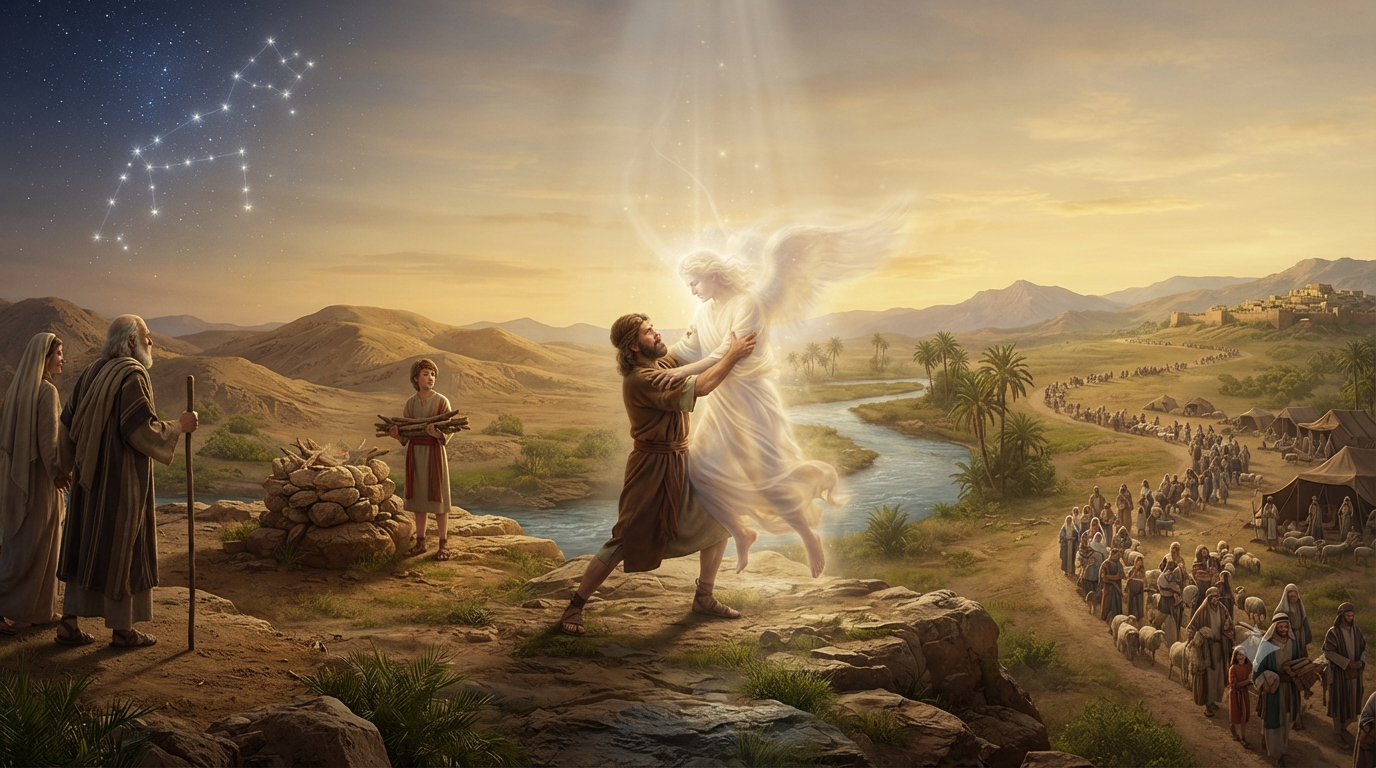
Afraid of the encounter, Jacob crosses the Jabbok River and remains alone during the night.
It is then that one of the most mysterious and important episodes in Genesis takes place.
The text says:
- “a man wrestled with him until daybreak.” > — Genesis 32:24
The narrative begins by referring to the figure as “a man,” but the text later gives the encounter a divine dimension.
When the episode ends, Jacob says:
- “I saw God face to face, and yet my life was spared.”
The book of Hosea also later refers to this story and speaks of Jacob's encounter with God and with an angel.
For this reason, the exact identity of this figure has been interpreted in different ways. What the narrative makes clear is that Jacob understands the encounter as an encounter with the divine.
And Jacob does not simply want to escape.
When morning comes, the man asks him to let him go.
Jacob replies:
- “I will not let you go unless you bless me.”
The response is significant.
The man asks:
- “What is your name?”
Jacob answers:
- “Jacob.”
Then comes the change:
- “Your name will no longer be Jacob, but Israel, because you have struggled with God and with men and have prevailed.”
The blessing Jacob receives is therefore connected to his own identity.
He enters that night as Jacob and leaves it with a new name: Israel.
The exact meaning of the name Israel is debated among scholars of the Hebrew language, but the text of Genesis itself provides an explanation connected to Jacob's struggle with God and with men.
This new name will have consequences far greater than Jacob himself could have imagined.
It will not simply be the name of an individual.
It will become the name by which his descendants are known.
Jacob will have twelve sons.
His descendants will be called the children of Israel.
And later, the tribes formed from his family will be known as the tribes of Israel.
This is where the story of the man called Jacob begins to become the story of the people called Israel.
The Sons of Israel
Jacob had twelve sons:
- Reuben
- Simeon
- Levi
- Judah
- Dan
- Naphtali
- Gad
- Asher
- Issachar
- Zebulun
- Joseph
- Benjamin
These sons form the basis of what became known as the twelve tribes of Israel.
The lists of the tribes found in the Bible differ somewhat depending on the context. This happens, among other reasons, because Joseph's descendants, Ephraim and Manasseh, later receive a tribal status of their own, while Levi has a particular role connected to religious service.
But the central idea remains: Jacob's sons form the genealogical foundation of Israel's tribal organization as presented in the Old Testament.
The story, however, has not yet reached the point when this family becomes a numerous people.
Before that, they will have to go to Egypt.
Joseph and the Journey to Egypt
Among Jacob's sons, Joseph receives special attention.
His brothers become jealous of him and eventually sell him into slavery. Joseph is taken to Egypt and, after many events, rises to a position of authority.
When a great famine strikes the region, his brothers go to Egypt in search of food.
The family is eventually reunited.
Jacob then goes down to Egypt with his sons and their families.
The book of Genesis ends with Jacob's descendants living there.
It is an important change of setting.
The family that began with Abraham is now established in Egypt.
But the situation will change dramatically in the next book.
Twelve Sons, Many Descendants
The book of Exodus begins by introducing a new generation.
The descendants of Israel had multiplied greatly.
A new Pharaoh, who did not know Joseph, begins to see this growing population as a threat. The Israelites are subjected to forced labor, and their situation becomes increasingly difficult.
It is in this context that Moses is born.
The narrative then shifts its focus.
Genesis primarily followed a family.
Exodus begins telling the story of a people.
Moses is called by God to deliver the Israelites from Egypt.
After the plagues sent against Egypt, the Israelites leave the land under Moses' leadership.
The Exodus will become one of the central events in Israel's collective memory.
The People at Sinai
Leaving Egypt, however, is not the end of the story.
After crossing the sea and traveling through the wilderness, the Israelites arrive at Mount Sinai.
There, something decisive happens.
God establishes a covenant with the people.
In Exodus 19, God presents himself as the one who brought them out of Egypt and addresses the descendants of Jacob, who are called the people of Israel.
From this point onward, Israel's identity takes on a dimension that goes beyond genealogy.
They are not merely descendants of Jacob.
They are also the people who were delivered from Egypt and who now enter into a covenant with God.
At Sinai, laws are given to guide the life of the community.
The story that began with a promise made to Abraham now reaches a new stage: Israel has a collective identity, a covenant, and a body of laws.
The Entry into Canaan
After the period in the wilderness, the biblical narrative presents the Israelites entering Canaan under the leadership of Joshua.
The book of Joshua describes conflicts, the distribution of territories, and the organization of the tribes.
It is in this context that Israel becomes associated not only with a family or a people on the move, but also with a land.
Later, during the period of the judges, the tribes live without a centralized monarchy.
Only later will the kingdom emerge.
This development is important because it prevents a common confusion: the Israel of Abraham was not yet the Kingdom of Israel that appears in the later historical books.
The name is the same, but the historical and political reality has changed.
Israel Is Not Yet a Kingdom
When Abraham appears in Genesis, there is no Kingdom of Israel.
When Jacob receives the name Israel, there is not yet one either.
During the Exodus, Israel already appears as a people, but not yet as a monarchy.
The kingdom will emerge much later, with Saul, David, and Solomon.
David establishes Jerusalem as the capital, and Solomon builds the First Temple.
After Solomon's death, however, the kingdom divides into two:
Israel, in the north,
and
Judah, in the south.
This will become one of the decisive events in biblical history.
What Can History Tell Us About All This?
Here we need to separate two questions.
The first is:
What does the Bible say about the origin of Israel?
The answer is the story we have just followed: Abraham, Isaac, Jacob, his sons, Egypt, the Exodus, Sinai, and the formation of the tribes.
The second question is:
What can we historically demonstrate about these events?
That question requires a different kind of investigation.
Historians and archaeologists work with ancient texts, inscriptions, archaeological remains, and other evidence to reconstruct the past.
This evidence does not allow us to treat every episode in the biblical narrative in the same way. Some periods have more abundant external sources; others are much more difficult to investigate.
For this reason, it is important not to confuse the biblical narrative with an archaeological reconstruction.
The Bible shows us how the Israelite tradition told the story of its own origins.
History and archaeology seek to investigate how Israel emerged within the context of the ancient Near East.
Both questions are important, but they are not exactly the same question.
So, Where Did Israel Come From According to the Bible?
The answer can be told as a story.
It all begins with Abraham.
God promises that his descendants will become a great people, but Abraham and Sarah have no children.
Ishmael is born to Hagar, but the narrative later presents Isaac as the son of the covenant.
Isaac has two sons, Esau and Jacob.
Jacob receives the name Israel.
His twelve sons become the ancestors of the twelve tribes.
The family goes down to Egypt.
There, their descendants multiply and eventually become enslaved.
Moses leads the people out of Egypt.
At Sinai, God establishes a covenant with Israel.
The narrative then presents their entry into Canaan and, centuries later, the emergence of the monarchy.
Thus, in the Bible, Israel does not begin with a king or a city.
It begins with a promise made to a family.
That family grows, passes through generations, goes to Egypt, and becomes a people.
This is the story behind the name Israel.
From Family to Kingdom
But an important part of the story is still missing.
How did the tribes of Israel become a monarchy?
Why did the Israelites want a king?
How did David rise to power?
Why did Jerusalem become so important?
And how, after Solomon, did Israel end up divided into two kingdoms?
These questions lead us to the next chapters of the story.
Biblical Readings to Continue
- Genesis 12 — the call of Abraham
- Genesis 15 — the promise of descendants
- Genesis 17–18 — the covenant and the announcement of Isaac's birth
- Genesis 21 — the birth of Isaac
- Genesis 25–35 — Isaac, Esau, and Jacob
- Genesis 32 — Jacob receives the name Israel
- Genesis 37–50 — Joseph and the family's journey to Egypt
- Exodus 1–15 — slavery and the Exodus
- Exodus 19–24 — the covenant at Sinai
- Joshua 1–24 — the entry into Canaan
- 1 Samuel 8–16 — the beginning of the monarchy
- 2 Samuel 5 — David and Jerusalem
- 1 Kings 1–12 — Solomon and the division of the kingdom
This article contains affiliate links. We may earn a commission from purchases made through them, at no extra cost to you.