What sources allow us to know the past?
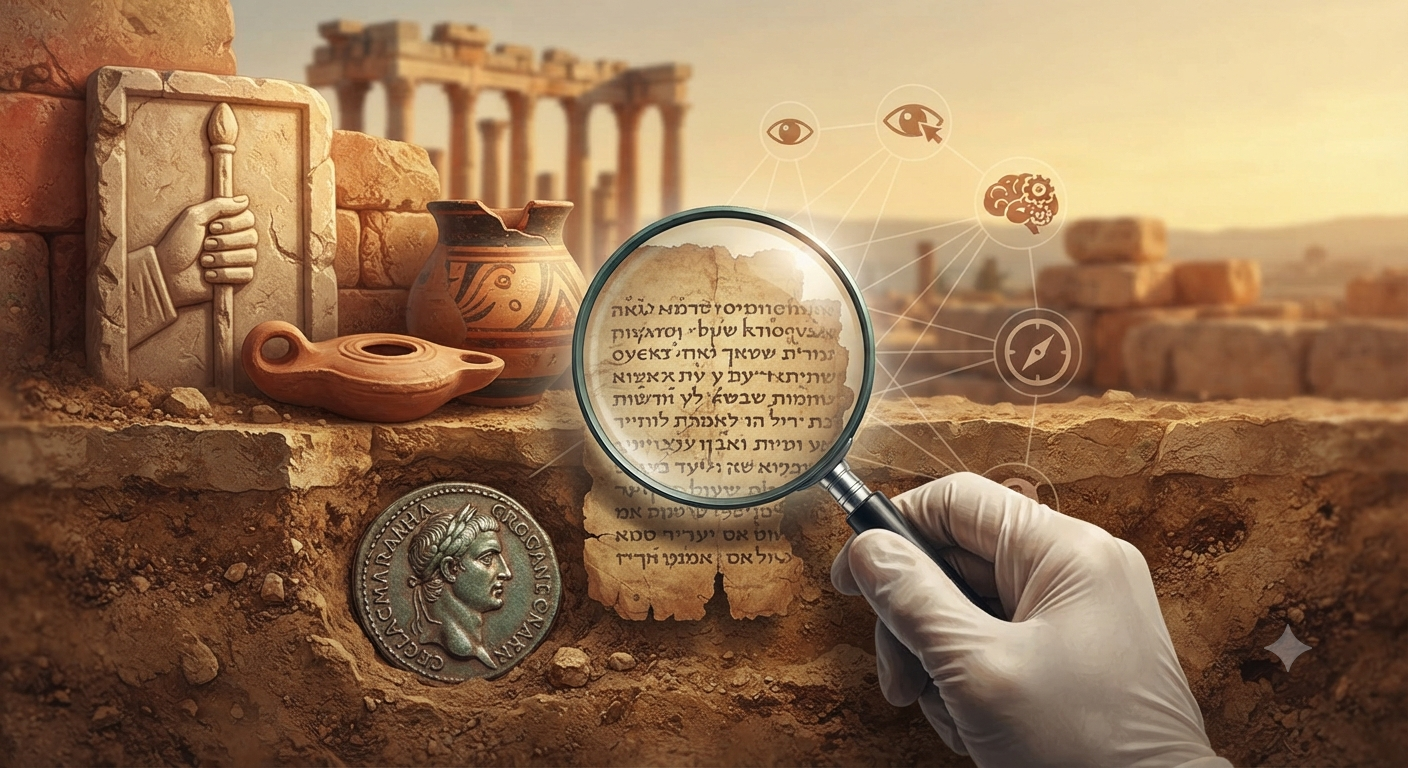
What sources allow us to know the past?
Manuscripts, inscriptions, coins, archaeology, and testimonies: how do we reconstruct a history we cannot directly observe?
Imagine someone hands you a box of objects found in a city that existed two thousand years ago.
There are some coins, pieces of pottery, an inscription carved in stone, the remains of a building, and a few manuscript fragments.
Could you discover anything about the people who lived there?
Probably yes.
Perhaps you could find out who ruled the region, which coins circulated, what language was used, what some of the buildings looked like, and even aspects of religion or daily life.
But there is a question behind all of this:
- How do we know what these traces mean?
In the previous article, we saw that Christianity emerged at a specific point in history and that its trajectory can be studied through evidence.
Now we need to look more closely at this evidence.
Because, when we start talking about Jesus, the first Christians, the councils, and the formation of the biblical canons, we will constantly be dealing with sources.
And knowing what a source is and how to evaluate it will make all the difference.
The past does not reach us intact
When we study recent events, we have access to an enormous amount of information.
There are photographs, videos, newspapers, recordings, official documents, messages, witnesses, and digital archives.
The further back in time we go, however, the more fragmented the record becomes.
Imagine trying to reconstruct a city that existed two thousand years ago.
Most of the people who lived there left no texts.
Many documents have disappeared.
Materials were destroyed by time.
Cities were abandoned or rebuilt.
Fires, wars, earthquakes, and political changes also destroyed evidence.
And even what has survived represents only a small part of what once existed.
This means that the historian does not have a complete recording of the past.
He works with traces.
The task is to discover what these traces can tell us.
Written texts
One of the most well-known sources is texts.
Letters, inscriptions, administrative documents, historical accounts, literary works, laws, contracts, and religious texts can preserve information about ancient societies.
This is precisely why manuscripts are so important for the study of Christianity.
The texts of the New Testament, for example, are fundamental sources for investigating the early Christian movement.
But they are not the only sources available.
There are also texts produced by authors who were not part of Christian communities.
And there are documents that were not written to speak about religion.
An administrative list, a commercial letter, or a legal document may seem much less interesting than a great historical account, but it can provide extremely valuable information about how a particular society functioned.
This leads us to a first rule:
- A source does not need to speak directly about the subject we are studying to be useful.
What about religious texts?
Here we need to make an important distinction.
A religious text can be studied historically.
This does not mean that the historian must accept or reject its religious message before examining it.
Imagine, for example, that we are studying an ancient Jewish community.
A religious text produced by that community can reveal:
- what beliefs it held;
- what practices it performed;
- which figures it considered important;
- how it understood God;
- how it interpreted historical events;
- what problems concerned its members.
Even if someone does not share that faith, the document remains an extremely important historical source for understanding what that community believed.
This distinction will be especially important when we study the biblical texts.
We can ask historically:
- What does this text show us about the community that produced or transmitted it?
And we can also ask theological questions:
- What does this text mean as a revelation of God?
These are different questions.
We do not need to confuse them in order to take either one seriously.
Manuscript is not the same as original
Here we encounter another important detail.
When we hear about an "ancient manuscript," we might imagine that we are looking at the very document written by the original author.
That is not always the case.
Many ancient texts have survived through copies of copies of copies.
The original may have disappeared.
This does not mean the text is useless.
It means we need to study its transmission.
Researchers compare manuscripts, observe differences, analyze linguistic and material characteristics, and seek to reconstruct, as far as possible, the history of the text.
This field of study is especially important for the Bible.
And it will be crucial when we reach the questions about:
Which manuscripts exist?
How were the texts transmitted?
Why are there differences between manuscripts?
How do researchers deal with these differences?
These questions are part of the so-called textual criticism.
We will get to that yet.
Inscriptions: when history is carved in stone
Not all information about the ancient world is in books.
Sometimes it is carved in stone.
Rulers, cities, religious communities, and individuals left inscriptions on different materials.
An inscription can record a name, a title, a dedication, a construction, a military victory, or another event.
And there is something particularly interesting about them:
many inscriptions were produced to be seen publicly.
This can provide a different perspective from that found in a literary text.
But again, we need to be careful.
An inscription produced by a ruler was probably not written to present an impartial evaluation of his own government.
It may celebrate his victories and omit his defeats.
Therefore, an inscription is not simply "the truth."
It is evidence that needs to be interpreted.
Coins tell stories
It might seem strange to imagine a coin as a historical source.
But it can carry a surprising amount of information.
Ancient coins can feature:
- names;
- faces;
- titles;
- symbols;
- deities;
- inscriptions;
- political imagery.
They can also help determine which authorities were present in a given region and period.
And there is an interesting advantage:
coins circulate.
A coin found in a particular location can help investigate economic relationships, the movement of people, and political influence.
It is a small object, but it can be part of a much larger historical picture.
Archaeology speaks without writing a single word
Perhaps one of the most interesting things about investigating the ancient world is realizing that we do not need a text to find evidence.
A destroyed city can leave layers of occupation.
A house can reveal how a family lived.
A cemetery can provide information about funerary practices.
Food remains can help us understand dietary habits.
Tools can reveal economic activities.
Architecture can show how certain spaces were used.
Archaeology allows us to study people who never wrote a book and perhaps never left a single recorded sentence.
This is particularly important because most people who lived in the ancient world probably did not leave written records that have survived to the present day.
Silence must also be interpreted
But there is a trap here.
Finding something is evidence.
Not finding something does not automatically mean it never existed.
Imagine someone says:
- "We found no documents about this person. Therefore, they never existed."
This conclusion may be premature.
It is possible that documents were destroyed.
Perhaps they were never produced.
Perhaps they have not yet been found.
Perhaps they survived but have not been identified.
The archaeological record is incomplete.
Therefore, the absence of evidence can be relevant in certain circumstances, but it cannot automatically be treated as proof of absence.
This is a small distinction, but an extremely important one.
What about witnesses?
Another important source is the accounts of people who claim to have witnessed events or received information from those who did.
A witness close to an event can provide valuable information.
But proximity does not guarantee absolute accuracy.
A person can forget details.
Can misinterpret something.
Can exaggerate.
Can omit information.
Can be defending a particular group.
Therefore, testimonies also need to be analyzed.
We ask:
Who was this person?
When did they write or speak?
Were they really in a position to know?
Was the account preserved directly or did it reach us through someone else?
Are there other pieces of evidence that confirm the account?
The more questions we can answer, the better we can evaluate the source.
And when multiple sources agree?
Here we arrive at one of the most useful ideas in historical investigation.
Suppose a single source says that a particular event happened.
That is information worth examining.
But imagine there are other independent pieces of evidence pointing to the same conclusion.
Now we have a stronger picture.
This can happen when different types of sources complement each other:
a text + an inscription + archaeology + coins
or:
a document + material evidence + sources from another region.
When different evidence converges, our confidence in the conclusion can increase.
This is especially important when we are studying ancient events, because no single source usually gives us the whole story.
Independent sources are especially important
There is a difference between ten people repeating the same story and ten independent sources pointing to the same conclusion.
Imagine that ten current websites publish exactly the same information.
That does not mean we have ten pieces of evidence.
Perhaps they all copied the same original article.
The same principle must be considered when studying ancient sources.
If five texts depend directly on a single earlier source, they do not automatically count as five independent testimonies.
Therefore, researchers seek to understand the relationships between sources.
Who depends on whom?
Which text is earlier?
Which one may have used another?
Which traditions appear independent?
These questions can be quite complex, but they are fundamental.
Context can completely change a source
A sentence taken out of its context may seem to say one thing but mean another.
This applies today and it also applied in the ancient world.
Therefore, when studying a document, we must consider its context.
Who wrote it?
In what period?
In which region?
What was the political landscape?
What conflicts existed?
Who was the audience?
What kind of text are we reading?
A poem does not function the same way as a contract.
A personal letter does not have the same purpose as an official inscription.
A religious narrative does not need to be read exactly like an administrative record.
The genre of the text matters.
What is a primary source?
Now we can return to a concept that appeared in the previous article.
A primary source is, broadly speaking, evidence directly related to the period or event we are studying.
It can be:
- a letter;
- an inscription;
- a coin;
- a manuscript;
- an administrative document;
- an archaeological structure;
- an object;
- a record produced by a person or community from that period.
But remember:
- Primary does not mean infallible.
A primary source is evidence close to the subject of study.
It is up to the investigation to discover what it can really tell us.
And what is a secondary source?
A secondary source is a later analysis that uses primary sources and other evidence to study a particular subject.
A historian can examine dozens or hundreds of pieces of evidence and produce a book or article explaining their interpretation.
Therefore, when you read an academic work about Jesus, Rome, or early Christianity, you are usually not looking at the "original source."
You are looking at someone who is interpreting a set of sources.
This does not make the work less important.
In fact, this is precisely where academic research comes in.
The researcher needs to know the sources, compare interpretations, evaluate arguments, and justify their conclusions.
And if two historians disagree?
This also happens.
And it does not necessarily mean that "no one knows anything."
Imagine two researchers examining the same evidence.
They may agree on the basic data but disagree on what it means.
One may consider a particular explanation more probable.
Another may attribute greater weight to another piece of evidence.
This divergence can be healthy.
It allows arguments to be tested.
The important thing is to find out:
- Why do they disagree?
What evidence does each use?
What assumptions underlie their conclusions?
Which argument best explains the body of sources?
Thus, studying history does not simply mean looking for "a historian who agrees with me."
It means understanding why a particular conclusion is defended.
And where does historical consensus fit in?
You will likely encounter this expression many times.
"Consensus" does not mean that absolutely all researchers agree.
In practice, it means that there is broad agreement among experts on a particular question.
For example, there may be enormous agreement on a basic event, while debates remain about its causes, details, or consequences.
Therefore, it is useful to separate two questions:
- Do historians agree that this happened?
and:
- Do historians agree on exactly how and why it happened?
The answers may be different.
History is not a machine for absolute certainty
Perhaps this is the most important part of this article.
When we study the past, we rarely have access to all the information.
Therefore, we should not expect history to function like a mathematical equation in which all answers appear with absolute certainty.
It works with evidence.
With comparison.
With context.
With probabilities.
With arguments.
With different levels of confidence.
Sometimes we can assert something with great certainty.
Sometimes we only reach a probable explanation.
Sometimes there are two or more reasonable possibilities.
And some questions remain open.
This does not make the investigation useless.
This is precisely how we distinguish well-supported knowledge from speculation.
And why does all this matter for studying Christianity?
Because from here on, we will begin dealing with much larger questions.
How do we know Jesus existed?
What can we know about his life?
What did his first followers believe?
How did Christianity spread?
When did certain controversies arise?
What really happened at the councils?
How were the biblical texts preserved?
How did different Christian communities receive their books?
Why are there different canons?
And how did the Christian tradition reach Ethiopia?
None of these questions can be answered simply by saying:
- "I believe."
But they also cannot be answered simply by saying:
- "It's all opinion."
We need to look at the sources.
One last question before we move forward
There is still one thing we need to learn.
We already know that sources exist.
We know they can be written, archaeological, material, or testimonial.
We know they can be compared.
We know they have limitations.
But one question remains:
- What exactly can we conclude from them?
Because finding an inscription does not automatically mean knowing the whole story behind it.
Finding a manuscript does not mean knowing everything about its author.
Finding an ancient city does not mean knowing all the people who lived there.
And finding an account about an event does not automatically mean that all the details of the account are proven.
We need to learn to differentiate evidence, conclusion, and interpretation.
That is the next step.
Next article
What can we truly know about the past?
Let's put all of this to the test.
How do we differentiate a very well-established conclusion from a probable hypothesis?
What does it mean to say something is "historically probable"?
When is evidence sufficient to support a conclusion?
And, most importantly:
where does what we can historically investigate end, and where do the questions of interpretation and faith begin?
Only after answering these questions will we be prepared to go back a few centuries in time.
And then, we will finally begin to get to know:
the world that existed before Jesus.
This article contains affiliate links. We may earn a commission from purchases made through them, at no extra cost to you.